
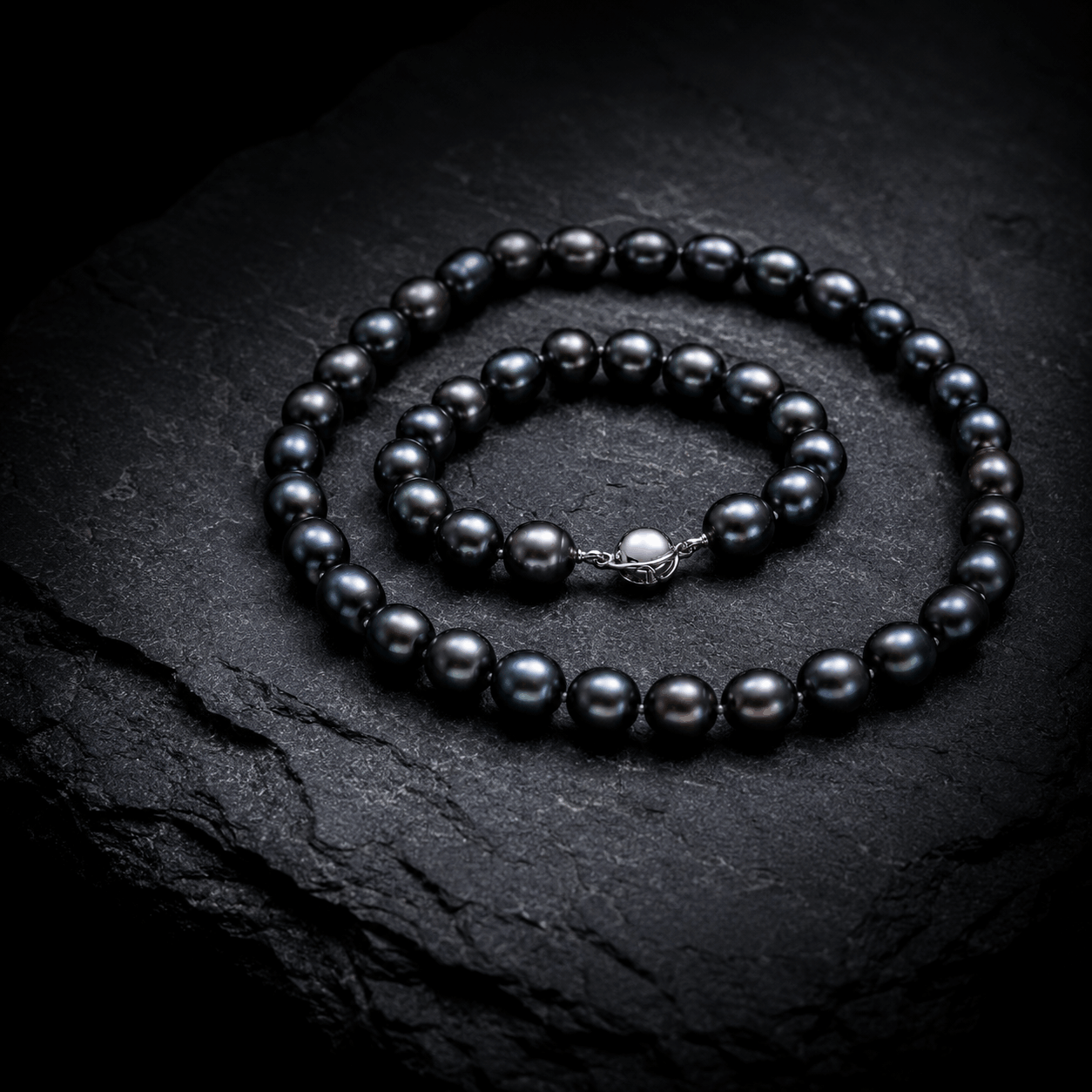
A customer messaged us once asking why the black pearl necklace she’d bought elsewhere looked nothing like the Tahitian pearls she’d seen in our store. Same color on the listing. Very different in person. The answer was simple — one was genuine Tahitian and the other was freshwater black pearls treated to achieve that dark color. So if you’re shopping for black pearl jewelry and want to understand exactly what you’re buying before spending money — here’s the honest breakdown.
What Are Freshwater Black Pearls
Freshwater black pearls are cultured freshwater pearls — grown in mussels in lakes and rivers, primarily in China — that have been treated after harvest to produce a dark black color. The pearl itself is genuine. The nacre is real. But the black color is applied through a dyeing or irradiation process rather than produced naturally by the mollusk. So freshwater black pearls are real pearls with an enhanced color — not fake pearls, not imitation pearls, but not naturally dark pearls either.

That distinction matters enormously when buying. Because genuine naturally dark black pearls — the Tahitian variety — come from the Pinctada margaritifera oyster in French Polynesia and carry that color entirely naturally. No treatment. No dye. The color comes from the oyster itself. And that’s a fundamentally different product from black freshwater cultured pearls where the dark color has been added after the fact. Both can be beautiful. But they’re not interchangeable — and the price, quality characteristics and long-term durability differ significantly between the two.
Black Freshwater Pearls vs Tahitian Pearls
This is the comparison most buyers need to make before spending money on black pearl jewelry. And the honest answer is that Tahitian pearls and black freshwater pearls are genuinely different in several important ways — not just origin.
Color is the most obvious difference. Tahitian pearls have a naturally dark body color with extraordinary overtones — peacock green-gold, aubergine, cherry, silver-green — that shift with the light in ways that are genuinely difficult to describe until you’ve seen them. That iridescent complexity comes from the nacre structure itself. Black freshwater pearls, on the other hand, have a dyed or irradiated color that tends to read as more uniform and flat. The black is dark and consistent — but it lacks the depth and overtone complexity of genuine Tahitian nacre. So side by side the difference is visible. Especially under natural light.

Size is another significant difference. Tahitian pearls typically run 8mm to 16mm. Black freshwater pearls are usually smaller — 6mm to 10mm in most commercial production. And luster, while strong in top-grade black freshwater cultured pearls, tends to be less dimensional than Tahitian saltwater luster because the nacre structure of freshwater pearls is different from saltwater varieties. None of this makes black freshwater pearls a bad choice — but it does make them a different choice. And knowing which one you’re actually buying is the whole point.
Are Dyed Black Pearls Worth Buying
Yes — with the right expectations. Dyed black freshwater pearls are genuine cultured pearls with real nacre. At top grades they have strong luster, good surface quality and genuine beauty. And they’re significantly more accessible in price than equivalent Tahitian pearls. So for buyers who want the dark aesthetic of black pearl jewelry without the Tahitian price point — black freshwater cultured pearls are a legitimate and genuinely attractive option.
The key consideration is durability. Dyed color in black freshwater pearls can fade over time — particularly with regular exposure to chemicals, heat or rough handling. So the care requirements are slightly stricter than for naturally colored pearls. Avoid perfume, hairspray and harsh chemicals near the pearls. Store separately. Wipe after wearing. Done consistently, that basic care extends the color lifespan considerably. And at the price point black freshwater pearls occupy, the value proposition — genuine pearl quality, striking dark aesthetic, accessible pricing — is genuinely strong.
What to Look For in a Black Pearl Necklace
A black freshwater pearl necklace is probably the most popular format in this category — and for good reason. A full strand of dark pearls is dramatic, versatile and genuinely striking at the right grade level. But quality varies enormously within the black freshwater pearl necklace category. So knowing what to evaluate before buying matters here more than in most pearl categories.

Luster first. Always. Even in dyed pearls, the underlying nacre luster should be strong — warm, dimensional and clearly visible under natural light. A dull or flat surface on a black freshwater pearl necklace indicates thin nacre or poor base pearl quality before dyeing. The dye can’t add luster that wasn’t there. Surface quality next — look for AAA or AA grade with minimal surface imperfections. And check color consistency across the strand. In a quality black freshwater pearl necklace the color should be uniform — no patchiness, no obvious variation between pearls that should read as matched. Color inconsistency across a strand is a sign of uneven dyeing or lower-grade base pearls. Browse the full black pearl collection at PearlsOnly to compare options across both black freshwater and genuine Tahitian varieties.
Jewelry Styles Worth Exploring
Black freshwater pearl jewelry works beautifully across multiple jewelry categories — not just necklaces. And the dark color creates specific styling opportunities that white or pink freshwater pearls don’t.

Black freshwater pearl earrings — studs or drops — are particularly effective. The dark color creates a clean, sophisticated look that reads as more contemporary than classic white pearl earrings. A pair of 8mm black freshwater pearl studs with strong luster is genuinely one of the most versatile everyday earrings available at an accessible price point. Bracelets work well too — a single strand of black freshwater cultured pearls on the wrist creates color contrast against skin that lighter pearl colors don’t. And black freshwater pearl sets — necklace, earrings and bracelet coordinated — offer the full dramatic impact of the dark aesthetic in a complete look that reads as genuinely considered.
How to Style Black Pearl Jewelry
The styling rules for black freshwater pearl jewelry are similar to those for Tahitian pearls — the dark color does the work so everything around it should be kept simple. But there’s a key difference in register. Tahitian pearls carry significant luxury weight — they naturally pull a look toward formal. Black freshwater pearl jewelry sits slightly more casually. Which is actually an advantage for everyday wear. A black freshwater pearl necklace with a white linen shirt and minimal other jewelry is effortlessly contemporary. The same piece over a black dress for an evening event reads as sophisticated without being overdressed.

For layering — a black freshwater pearl strand at 18 inches paired with a shorter delicate silver chain at 16 inches creates a clean two-layer look where the dark pearl leads and the metal provides contrast. Keep everything else minimal. The dark color commands enough attention on its own. And for mixing — pairing a freshwater pearl black bracelet with a white pearl necklace creates a contrast-led look that’s genuinely current in 2026 pearl jewelry styling. Organic dark versus organic white. No other colors needed.
Buying Black Freshwater Cultured Pearls — Key Questions to Ask
Before buying any black freshwater pearl jewelry, a few questions are worth asking explicitly rather than assuming. First — is the color natural or treated? Any reputable seller answers this clearly. Natural black color in freshwater pearls essentially doesn’t exist — if a seller claims their black freshwater pearls are naturally colored, that’s a red flag worth investigating. The color is almost always from dyeing or irradiation.

Second — what is the base pearl quality before treatment? The dyeing process doesn’t improve the underlying pearl. So luster, surface quality and nacre thickness in the base pearl determine the quality of the finished piece. Third — what is the surface grade? AAA means near-flawless across every pearl. AA has minor marks but reads beautifully in wear. And fourth — what’s the return policy? A minimum of 30 days should be standard. At PearlsOnly every black freshwater pearl piece comes with full documentation and a 90-day return guarantee — so you buy with complete confidence regardless of which piece you choose. Browse the full black pearl collection and find the piece that fits exactly what you’re looking for.
