
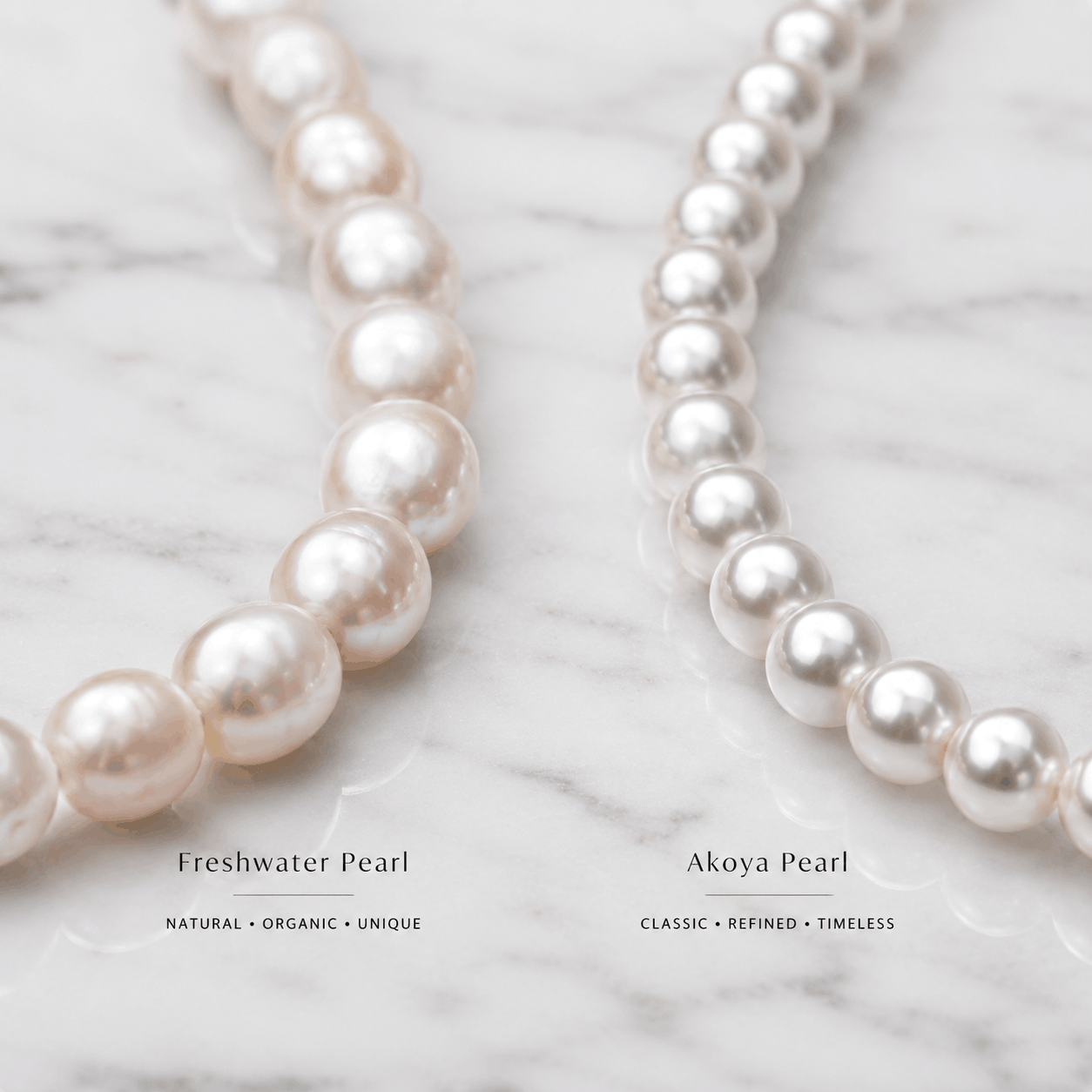
Someone asked me this at a jewelry fair once — “so are these freshwater or cultured?” — like she had to pick one or the other. And honestly that confusion makes complete sense. The terminology is genuinely misleading if nobody explains it properly. So here’s the real answer to freshwater pearls vs cultured pearls — and why the comparison most buyers are actually trying to make is a different one entirely.
Freshwater Pearls vs Cultured Pearls — The Short Answer
Freshwater pearls are cultured pearls. That’s the short answer. But the two terms describe different things — one tells you where a pearl grew, the other tells you how it grew. “Freshwater” refers to the environment — lakes and rivers rather than oceans. “Cultured” refers to the farming method — a human farmer started the pearl’s formation by introducing a small irritant into the mollusk. So freshwater cultured pearls grew in freshwater environments through the cultured farming process. Not an either/or. Both at once.
Almost all freshwater pearls sold today are cultured. And almost all pearls in fine jewelry anywhere — freshwater or saltwater — are cultured too. Genuine natural pearls, formed entirely without human involvement, are extraordinarily rare. They mostly turn up in antique collections and at auction. So when comparing freshwater pearls vs cultured pearls, the distinction you’re actually trying to understand is freshwater versus saltwater. That’s the comparison that matters for quality, price and style.
Growing Environment — Freshwater vs Saltwater
Freshwater cultured pearls grow inside freshwater mussels — primarily a hybrid of the Hyriopsis cumingii — farmed in the lakes and rivers of China. China produces by far the most freshwater pearls in the world and has developed extraordinarily sophisticated farming techniques over recent decades. So the result is a pearl type that has improved dramatically in quality while staying significantly more accessible in price than saltwater alternatives.

Saltwater cultured pearls, on the other hand, grow in oysters farmed in ocean environments. The three main types are Japanese Akoya pearls, Tahitian pearls and South Sea pearls — each from a different oyster species in different ocean regions. And each produces something genuinely distinctive. Akoya pearls deliver sharp mirror-like luster and near-perfect roundness. Tahitian pearls produce extraordinary naturally dark colors — peacock, aubergine, cherry — that freshwater pearls simply can’t replicate naturally. And South Sea pearls are the largest cultured pearls available, running 9mm to 20mm with that distinctive satiny luster. All three are saltwater cultured pearls. But none are more real than freshwater. They’re all genuine.
The Comparison That Actually Helps Buyers
Since almost all pearls today are cultured, the comparison that helps buyers make better decisions is freshwater versus saltwater. So here’s how they differ across the quality factors that matter most.

| Feature | Freshwater Cultured Pearls | Saltwater Cultured Pearls |
|---|---|---|
| Growing environment | Lakes and rivers | Oceans and seas |
| Nacre thickness | Usually very thick — often nearly solid nacre | Varies — often thinner over a bead nucleus |
| Luster quality | Soft internal glow — beautiful but less sharp | Sharp mirror-like (Akoya) or deep satiny (South Sea) |
| Shape | Near-round to baroque — organically varied | More uniformly round (especially Akoya) |
| Color range | White, cream, pink, peach, lavender | White, cream, black, golden (varies by type) |
| Size range | 2mm to 16mm typically | 5mm to 20mm depending on type |
| Durability | Excellent — thick nacre holds up well daily | Good — but thinner nacre more sensitive to wear |
| Price | Significantly more accessible | Higher — sometimes considerably so |
| Best for | Daily wear, gifting, first pearl pieces | Investment pieces, formal occasions, collectors |
Nacre — The Factor Nobody Talks About Enough
Nacre is the layered crystalline material a mollusk deposits around an irritant to form a pearl. It gives a pearl its glow, its depth and its durability. And it’s the single most important quality factor in any pearl — freshwater or saltwater — that most buyers never think to ask about.

In top-grade freshwater pearls, the nacre runs extraordinarily thick — often 1.5mm to 3mm or more, sometimes nearly solid through the entire pearl. So that thickness creates a soft luminous glow that deepens with wear rather than dulling. Scratch it slightly and you’re still in nacre — not hitting a bead core underneath. In bead-nucleated Akoya pearls, on the other hand, the nacre layer is thinner — typically 0.4mm to 0.7mm in standard quality. That thinner layer produces the famous sharp mirror-like Akoya luster. But it also makes Akoya pearls more sensitive to daily wear and chemicals. Neither approach is wrong. But understanding nacre thickness changes how you think about value across the freshwater vs saltwater comparison entirely.
Are Freshwater Pearls Real
Completely. Freshwater cultured pearls are genuine pearls in every meaningful sense. They form inside a living organism through the same biological process as any other pearl — a mollusk coating an irritant in layers of nacre over months or years. The human involvement only starts the process. The mollusk does everything else after that. So freshwater pearls are not synthetic, not fake and not imitation in any way.
The confusion between cultured and fake pearls is one of the most persistent misconceptions in fine jewelry. Fake pearls — glass, plastic or shell-coated imitations — contain no nacre at all. Cultured pearls, whether freshwater or saltwater, are organic gems with genuine nacre layers. So if you want a quick check — rub a pearl against your tooth. Real nacre feels gritty. A fake feels completely smooth. Takes five seconds. Works every time.
When to Choose Freshwater Cultured Pearls

Freshwater cultured pearls suit most buyers in most situations. For daily wear — the thick nacre holds up to regular use in a way thinner-nacre saltwater pearls don’t always manage. So a freshwater pearl bracelet worn every day will look better for longer than an equivalent Akoya piece at the same price point. For first pearl purchases — the accessible price means you can invest in genuinely good quality without overcommitting. For gifting — freshwater pearl jewelry spans every category across a wide range of price points. And for color — pink, lavender, peach or multicolor options exist naturally only in freshwater. Browse the full freshwater pearl collection at PearlsOnly to find the right piece.
When Saltwater Pearls Are Worth the Premium
Saltwater cultured pearls make sense when specific qualities matter more than price. Want the sharpest possible round white luster — the classic pearl look that defined fine jewelry for a century? Akoya is the benchmark and nothing else quite matches it. Want naturally dark dramatic color with extraordinary overtones? Tahitian is the only genuine option. Want the largest most impressive pearl presence available? South Sea is in a category of its own.

For investment pieces, heirloom jewelry and occasions where the pearl type carries meaning beyond the piece itself, saltwater pearls justify the premium. Browse the full saltwater range — Akoya, Tahitian and South Sea — at PearlsOnly to compare across every type, grade and price point.
FAQ: Freshwater Pearls vs Cultured Pearls
Are freshwater pearls and cultured pearls the same thing? Almost always yes. The vast majority of freshwater pearls sold today are cultured. So the terms describe where and how a pearl grows — not two different categories of pearl.
Which is better — freshwater or saltwater cultured pearls? Neither is universally better. Freshwater cultured pearls offer thicker nacre, better durability, wider color options and more accessible pricing. Saltwater cultured pearls offer sharper luster, natural dark color or exceptional size. The right choice depends entirely on what matters most for the specific piece.
Are cultured pearls fake? No. Cultured pearls are real pearls. They form inside living mollusks through genuine biological processes — a farmer introduces the initial irritant, then the mollusk creates the pearl. The nacre, the luster and the pearl itself are completely genuine.
Why are freshwater pearls cheaper than Akoya or South Sea pearls? Freshwater pearl farming is more productive — a single mussel produces multiple pearls simultaneously and the cultivation cycle is shorter. That efficiency drives prices down without compromising nacre quality at the top grades.
