
My aunt showed up at Christmas wearing a pearl necklace she’d bought at an airport gift shop for forty dollars. Beautiful looking strand. Very convincing. Then she rubbed one against her tooth and her face dropped. Smooth as glass. Total fake. And the worst part? She’d been wearing them for three years thinking they were real. So if you’ve ever wondered how can you tell if pearls are real — here are the tests that actually work. Quick, simple and you can do most of them right now.
How Can You Tell If Pearls Are Real by Looking
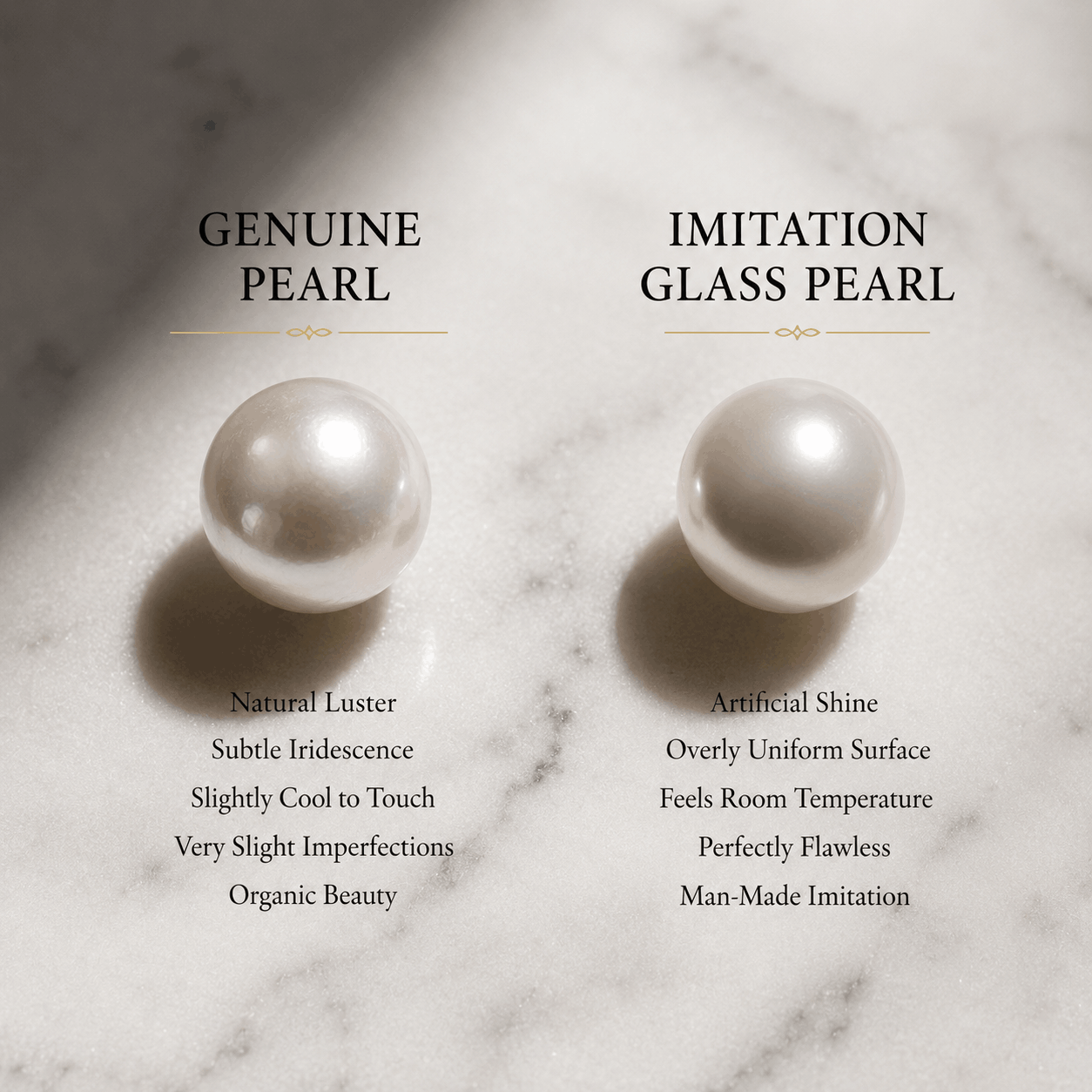
Start with your eyes before anything else. Genuine pearls grow inside a living oyster or mussel over months or years. And that natural process leaves marks. Tiny surface ridges. Slight shape variations from one pearl to the next. A subtle imperfection here and there. Fake pearls — glass, plastic or shell-coated — get manufactured to a perfect uniform standard. So they all look identical. Too smooth, round & too consistent.

So hold the strand up and look along it. If every single pearl is a perfect copy of the one next to it, that’s actually suspicious. Real strands — even premium AAA grade ones — show slight natural variation. But that tiny inconsistency is exactly what genuine looks like. Perfection, oddly enough, is the red flag here.
The Tooth Test: Fastest Way to Tell If Pearls Are Real
This is the one everyone should know. Gently rub the pearl along the edge of your front teeth. Real pearls feel gritty — almost like fine sand — because of the layered nacre structure built up over time. Fake pearls, though, feel completely smooth. Glassy. No texture at all.

Sounds strange the first time. But honestly the difference is unmistakable once you’ve felt both. So try it on a pearl you already know is genuine first — just so you know exactly what gritty feels like before testing anything uncertain. Takes five seconds. Costs nothing. Works almost every single time.
Weight, Temperature and Surface — More Ways to Tell
Real pearls feel heavier than you’d expect for their size. Nacre is a dense organic material — so even a small pearl has noticeable heft. Plastic fakes feel hollow and light by comparison. Glass fakes can fool you on weight, but they still fail other tests so don’t stop there.

Temperature is another quick one. Press the pearl against the inside of your wrist or your lips. Real pearls feel cool at first and warm up slowly — the same way stone or ceramic would. Plastic, on the other hand, stays at room temperature or feels slightly synthetic from the start. And under good natural light, real pearls show a soft layered glow that shifts as you turn them. Fakes throw back a flat harsh shine with no depth behind it. Once you see both side by side, you’ll never confuse them again.
How Can You Tell If Pearls Are Real by Checking the Drill Holes
This one gets overlooked a lot. But it’s genuinely reliable — especially on necklaces or bracelets. So zoom in on the drill holes with your phone camera. Real pearls show clean sharp edges at the hole and you can often see the nacre layers right at the rim. That layered structure is genuinely hard to replicate artificially.

Fake pearls tell a different story at the drill hole. Rough or chipped edges. Sometimes the coating is already starting to flake or peel right at that point — because drilling is exactly where a painted surface breaks down first. So if you spot peeling anywhere near the hole, the question answers itself pretty quickly.
Real vs Fake Pearls: Quick Comparison
Before running any test, here’s a side-by-side look at the key differences between genuine pearls and imitations across the most important quality factors.
| Feature | Real Pearls | Fake Pearls |
|---|---|---|
| Surface texture | Slightly gritty with natural ridges | Perfectly smooth and uniform |
| Luster | Deep layered glow that shifts with angle | Flat harsh shine with no depth |
| Shape | Slight natural variation pearl to pearl | Perfectly identical across the strand |
| Weight | Noticeably dense and heavy | Light or hollow feeling |
| Temperature | Cool at first, warms gradually | Room temperature or plasticky feel |
| Drill holes | Clean edges with visible nacre layers | Rough or chipped, coating may peel |
Common Fake Pearl Types Worth Knowing
Not all fake pearls are the same. Some are obviously cheap. Others are surprisingly convincing — at least until you know what to look for. So here’s a quick breakdown of the most common imitation types in the market right now.

Glass pearls — Coated glass beads. Heavier than plastic which fools some buyers on weight. But the coating chips and peels around drill holes and there’s no real nacre underneath. Plastic pearls — The most obvious fakes. Light, hollow feel and stays at room temperature. Very common in costume jewellery and easy to spot once you’ve handled a real pearl even once. Shell pearls — Ground oyster shell compressed and coated. Smooth, too uniform and with no natural imperfections whatsoever. Majorica pearls — High-end Spanish imitations with a fish-scale coating. Honestly the most convincing fakes available. Decent weight, reasonable shine. But there’s no real nacre structure — and the tooth test still catches them every time.
How Can You Tell If a Full Pearl Necklace Is Real
Testing a full piece rather than a single loose pearl? Then a few extra details are worth checking. Look at the clasp first. A genuine pearl necklace typically has a solidly built clasp — often in sterling silver or gold — because the piece around it is worth protecting. So a flimsy or lightweight clasp on something sold as fine jewellery is an immediate red flag.

Then check the stringing. Quality pearl necklaces use silk thread with a small knot tied between each individual pearl. Those knots stop pearls rubbing against each other and mean that if the thread ever breaks, you lose one pearl at most — not the whole strand at once. No knots between pearls usually means the piece wasn’t built to last. And always ask for grading documentation. Any reputable seller hands that over without hesitation — so if they can’t or won’t, that’s your answer right there.
Types of Real Pearls and What Makes Each Genuine
Once you know how can you tell if pearls are real, it helps to understand what genuine varieties actually look like. Real pearls come in several types — and each one looks quite different depending on where and how it was grown.

Akoya pearls — The classic. Grown primarily in Japan and known for sharp mirror-like luster and near-perfect roundness. Typically 5mm to 9mm. Still the most recognizable pearl type in traditional fine jewellery. Tahitian pearls — Naturally dark with extraordinary peacock, aubergine and midnight green overtones. No dye involved — so that colour is completely natural. Grown in French Polynesia, typically 8mm to 15mm. South Sea pearls — The largest and rarest cultured pearls available. 10mm to 20mm, thick nacre and a satiny deep luster unlike anything else. Genuine investment-level pieces. Freshwater pearls — Grown in lakes and rivers, mainly in China. Most accessible price point of all genuine pearls. Plus they come in whites, pinks, lavenders and peaches — exceptional quality at the top grades.
When Home Tests Aren’t Enough
Home tests cover most everyday situations well. But for anything genuinely valuable — or anything you’re about to spend serious money on — take it to a jeweller or gemologist. X-ray imaging shows the concentric nacre growth rings inside a real pearl that no imitation can replicate. Plus magnification under proper lighting reveals nacre structure clearly. And some genuine pearls fluoresce under UV light in ways fakes simply don’t.
At PearlsOnly every pearl piece comes with full grading documentation and a certificate of authenticity. So you never have to wonder how can you tell if pearls are real after the fact. Browse the full collection and buy knowing exactly what you’re getting — with a paper trail, not just a promise.
FAQ: How Can You Tell If Pearls Are Real
Is the tooth test actually reliable? Yes — and for most everyday situations it’s the fastest and most accessible check available. Gritty means real nacre. Smooth means coated imitation. The only exception is very high-end fakes like Majorica pearls, which can feel slightly less smooth — but even those don’t replicate the genuine gritty texture of real nacre layers.
Can cultured pearls fail the tooth test? No. Cultured pearls are genuine pearls — grown inside a living oyster or mussel with real nacre coating the nucleus. So they feel gritty on the tooth test just like natural pearls do. Cultured simply refers to how the process started, not the material itself.
Do real pearls ever look perfect? Rarely. Even high-grade AAA pearls show minor natural variation up close. So a strand that looks absolutely flawless and perfectly uniform across every single pearl is more likely to be an imitation than a genuine high-quality piece.
What’s the single most reliable home test? The tooth test — fast, free and works almost every time. But combine it with a visual check and a look at the drill holes for the most confident result without needing any equipment at all.
