
Bought what I thought was an Akoya strand at a market stall years ago. Got it appraised later. Freshwater. Decent quality freshwater, actually — just not what I paid for. That mistake taught me how to tell Akoya from freshwater pearls properly, and it’s honestly not that hard once you know what to look for. The two get confused constantly because they can look similar in low light or bad photos online. But up close, side by side, the differences are real and visible. So here’s exactly what separates them.
Are Akoya Pearls Saltwater or Freshwater
Let’s settle this first because it comes up constantly. Akoya pearls are saltwater pearls. They’re grown in Pinctada fucata oysters in the cold coastal waters of Japan — mainly Mie, Ehime and Nagasaki prefectures. Freshwater pearls, on the other hand, grow in mussels in freshwater lakes and rivers, primarily in China. The water source is different. So is the mollusc. So are the growing conditions entirely. That distinction is the root of every other difference between the two.

Saltwater conditions in Japan are colder and the oysters grow more slowly. That slower growth produces tighter, denser nacre layers. Freshwater mussels grow faster in warmer water, which creates a different nacre structure. Neither is “fake” or inferior in an absolute sense. They’re just structurally different pearls. So when someone asks are Akoya pearls saltwater or freshwater, the answer is simple — saltwater, always. If a seller calls something Akoya and it’s not saltwater, that’s mislabelling.
How to Tell Akoya from Freshwater Pearls by Luster
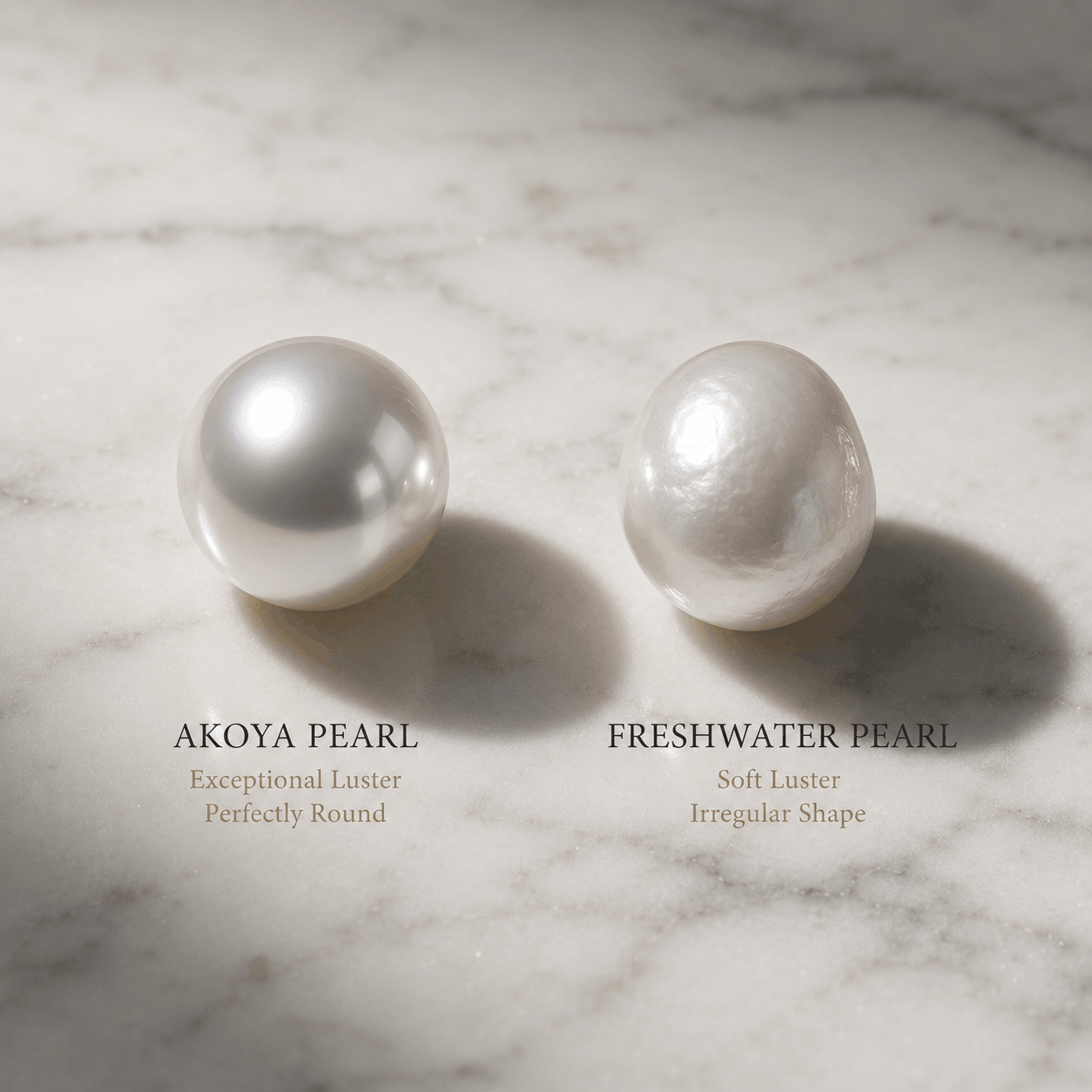
Luster is the single biggest giveaway. Akoya pearls have a sharp, almost metallic luster. Look at one under a lamp and you’ll see a crisp, well-defined reflection of the light source — almost like looking at a small mirror. Freshwater pearls have a softer, more diffused glow. Beautiful in its own way, but noticeably different. The light source blurs slightly rather than reflecting cleanly.

Hold both types side by side under the same light and the difference becomes obvious within seconds. Akoya looks bright and sharp. Freshwater looks warm and soft. Neither is better universally — it depends what look you want — but this single test is the fastest way to tell akoya pearls freshwater apart from genuine saltwater Akoya. Photos online often hide this difference, which is exactly why so many buyers get confused before purchasing.
Akoya vs Freshwater Pearls: Shape and Size Differences
Shape is the second major clue. Akoya pearls are almost always perfectly round or very close to it. The farming process and the oyster’s biology naturally produce that round shape consistently. Freshwater pearls come in a much wider range of shapes — round, near-round, oval, button, drop and baroque. So if you’re looking at a strand with slight irregularities or varied shapes, you’re very likely looking at freshwater, not Akoya.

Size differs too. Akoya pearls typically run 6mm to 9mm, occasionally reaching 10mm in rare premium harvests. Freshwater pearls can grow larger — sometimes 10mm to 13mm — because the mussel can produce multiple pearls at once and isn’t limited the same way. So a large, perfectly round white pearl labelled Akoya at 11mm or 12mm should raise immediate suspicion. That size in true round Akoya is exceptionally rare and would carry an exceptionally high price tag to match.
Price Is a Reliable Clue Too
Here’s something practical. Genuine Akoya pearl necklaces simply cost more to produce than freshwater. The farming process, the oyster species and the saltwater environment all add cost that gets reflected in the final price. A full strand of real Akoya pearls rarely sells for under $200 to $300 USD even at entry-level quality. If you see something labelled Akoya at $50 or less for a full strand, it almost certainly isn’t genuine saltwater Akoya — it’s freshwater, possibly mislabelled either by mistake or intentionally.

That price gap is one of the most reliable practical tools for telling akoya vs freshwater pearls apart before you even examine the physical pearl. Combine the price check with the luster and shape tests and you’ve got a genuinely solid method for verifying what you’re actually buying. Sellers who can’t explain the price difference, or who claim genuine Akoya at suspiciously low prices, are worth walking away from.
Checking the Nacre and Weight
Akoya pearls have thinner individual nacre layers than South Sea pearls but a denser overall structure due to the cold water growth. This gives them a slightly heavier feel for their size compared to freshwater pearls of similar dimensions. It’s subtle — you need to hold both in hand to really notice it — but experienced buyers do pick up on it.

Freshwater pearls, because they often have a slightly different internal structure and sometimes a small bead nucleus or none at all depending on the farming method, can feel marginally lighter. This isn’t a definitive test on its own, but combined with luster and shape, weight becomes one more data point that helps confirm what you’re actually holding. A jeweller’s loupe can also reveal surface texture differences if you want to go a level deeper.
Buying with Confidence: What to Ask Before You Purchase
So once you know how to tell Akoya from freshwater pearls visually, the next step is verifying it through documentation. Always ask for a grading certificate that states pearl type explicitly — not just “pearl” but “Akoya saltwater cultured pearl” or “freshwater cultured pearl.” Vague labelling is the single biggest red flag in the pearl market. Reputable sellers state this clearly because they have nothing to hide.
At PearlsOnly, every Akoya pearl and every freshwater pearl piece is labelled accurately with full grading documentation, so you never have to guess what you’re buying. Both pearl types are genuinely beautiful in their own right — this isn’t about one being better than the other. It’s about knowing exactly what you’re paying for and making sure the price matches the product. Browse the full collection and compare both types side by side before making your decision.
